

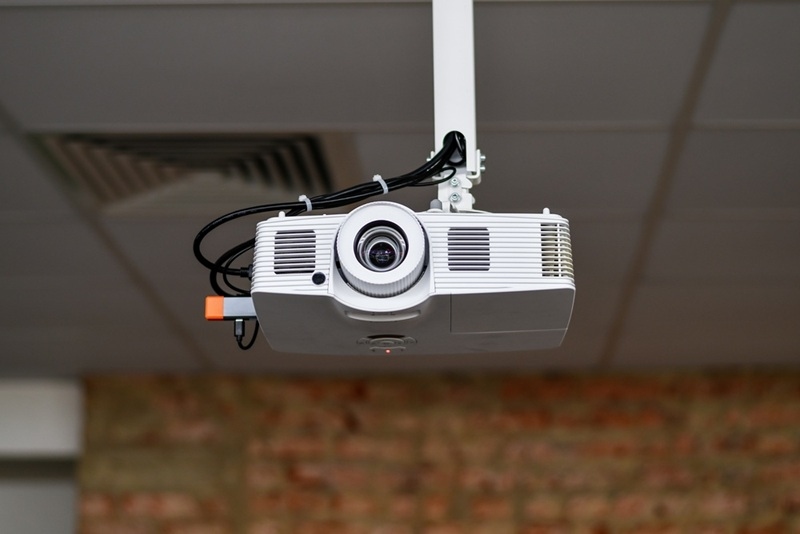
You finally got a projector. You picked the screen, planned the room, and now one decision is holding you up: ceiling or wall? The wall mounted vs ceiling mounted projector debate matters more than most people expect because where the unit goes affects picture quality, viewing comfort, cable management, and how finished the room actually feels. Understanding the ceiling vs wall mount projector difference early keeps you from making costly changes later. Some homeowners want a clean overhead installation, while others prefer a wall vs ceiling projector setup that stays fixed but remains easy to reach. This projector placement guide covers the pros, drawbacks, and best use cases for both so you can pick what genuinely works for your space.
Before choosing, it helps to see what each setup actually involves.
A ceiling mount attaches the projector overhead using a bracket or pole. It hangs upside down and flips the image automatically through settings. Once installed, it is not going anywhere.
A wall mount fixes the projector to the rear or side wall at a set height. It points straight at the screen and holds its position without any overhead work involved.
Both are solid projector mounting options. The right call comes down to your room size, projector type, and how you use the space daily.
For anyone putting together a serious home theater projector setup, ceiling mounting tends to be the first choice.
The downsides are real, though. Installation takes time and sometimes professional help. Adjustments after mounting are awkward, and cleaning the lens always means dragging out a ladder.
Best for: Dedicated home theaters, large living rooms, conference spaces, and standard or long-throw projectors.
The wall vs ceiling projector setup debate rarely gives wall mounting the credit it deserves for everyday home use.
Worth noting, though, wall mounts still need drilling and some cable planning. You also need enough wall depth behind your seating to hit the right throw distance for the screen size you are using.
Best for: Rooms with low or vaulted ceilings, anyone wanting a permanent setup without overhead installation, and standard or long-throw projectors running from the rear wall.
Working through these will settle the ceiling vs wall mount projector question faster than anything else. Each one directly affects which projector mount is better for your specific room.
Ceiling mounts need at least 8 feet of clearance to work comfortably. Anything lower or angled works better with a wall mount every time.
UST and short-throw models need to sit close to the screen. Standard and long-throw units need distance, making the rear wall or ceiling the natural fit.
Committing to a theater room? The ceiling mount installation is worth every bit of the effort. Want something locked in but still reachable without a ladder? Wall mounting is the better answer.
Ceiling installs hide cables above and leave the room looking intentional. Wall mounts route cables along the wall, which stay clean with basic conduit or cable covers.
Wall mounting generally costs less than ceiling installation. A ceiling mount adds brackets, poles, and potentially $100 to $300 or more in professional labor on top of that.
This question comes up constantly in any projector placement guide, and the honest answer is no, not when you set it up right.
Ceiling and wall mounts both produce the same image quality when aligned properly. What causes trouble is a bad angle. Tilt the projector too far in any direction and keystone distortion kicks in, making the image look like an uneven trapezoid. Digital correction handles this on most modern projectors, but getting the physical angle right first is always the smarter move.
Shadow interference is less of a concern with wall mounts since the unit sits at a fixed height behind the viewing area. For a dedicated home theater projector setup, ceiling mounting with optical lens shift still edges ahead on pure image geometry, though a well-placed wall mount gets surprisingly close.
Still weighing which projector mount is better? This cuts it down fast.
Go with a ceiling mount if you:
Go with a wall mount if you:
A rear-wall shelf sits nicely between both options. It is one of the more practical projector mounting options available, giving you a stable fixed height without drilling into the ceiling at all.
There is no clear winner in the wall mounted vs ceiling mounted projector debate because the right answer shifts with your room, your projector, your budget, and your plans. Breaking down the ceiling vs wall mount projector choice, honestly, a ceiling install feels more permanent and keeps the room cleaner, while a wall mount gives you a solid fixed position that is genuinely easier to live with day to day. Both produce excellent picture quality when set up properly. Whichever wall vs ceiling projector setup fits your space, commit to the placement, align it carefully, and your projector will perform well for years.
Most wall mount brackets come with straightforward instructions and standard hardware. If you can locate a wall stud, use a drill, and follow a level, the job is manageable solo. Complicated cable routing behind drywall is really the only part worth hiring someone for.
Wall mounts pair well with fixed frame and motorized screens since the throw angle stays consistent. Pull down manual screens can sometimes cause alignment headaches depending on how level your wall surface is. Measuring throw distance carefully before drilling saves a lot of adjustment trouble later.
This depends entirely on your projector's throw ratio and screen size. A standard throw projector typically needs 10 to 15 feet of distance from the screen. Check your projector's manual for the exact throw ratio and calculate from there before committing to a wall position.
This content was created by AI