

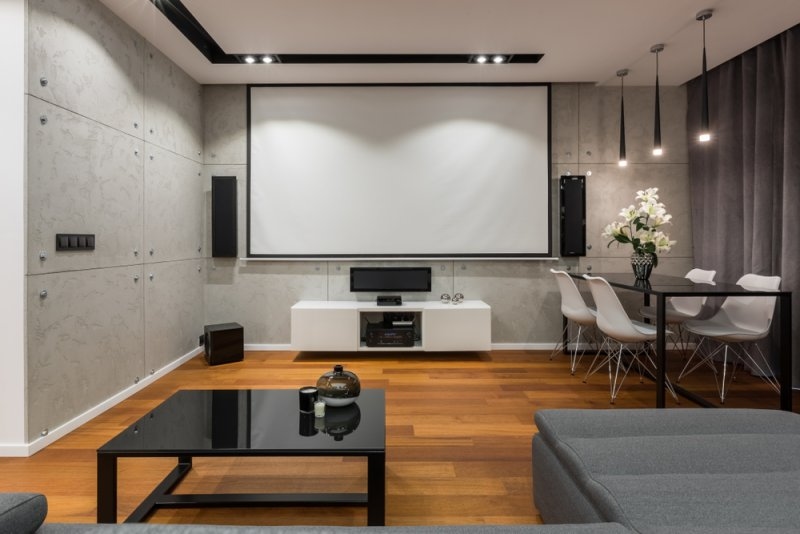
Your projector's most suitable screen gain is a result of the room's lighting, the projector's brightness, the size of your screen, and where you are sitting. Distance and the material of the projector screen are key considerations, and the gain of a projection screen affects the brightness and evenness of the image.
If you are aware of the projector screen, then you may pick the best projector screen for your projector and room. Whether you are building a home theatre or upgrading an existing one, selecting the right gain is important.
So, what is projector screen gain? Gain measures how much reflected light the screen will send to viewers in comparison to a normal 1.0 gain screen. A gain of 1.0 is what you'd consider "normal" or neutral, and anything higher is more reflected light in the screen's designated direction.
The concept of gain is better grasped if you think of reflected light. For example, a 1.3-gain screen can bounce additional light to the middle of the display compared to 1.0-gain screens. Gain is also not responsible for uniform brightness; the manner in which the screen distributes light is also responsible for image viewing angles.
The brightness of the projector screen. This is the biggest reason folks get into a debate about how much gain a screen should have. When the projector's light output is on the low side, or there is some ambient light in the room, a higher gain screen can look brighter.
Don't forget about projector screen gain with projector screen brightness and size. Large screen material distributes the light it gets over a much larger area, while brightness (lumens) increases the amount of light a projector outputs. Gain helps, but it's nothing without enough projector screen brightness, as it's just another aspect of your whole setup.
As for high-gain vs low-gain projector screens, it is a matter of balancing between brightness and viewing experience. Because higher-gain projector screens project the reflected light in a more concentrated fashion, this can mean a brighter image for viewers positioned near the ideal viewing area. Let's see: “What is the difference between 1.0 and 1.3 screen gain?”
No single option is better. The layout of your room and where people sit are more significant than the gain number.
The difference between projector screen gains of 1.0 vs 1.3 is quite straightforward. While a 1.0-gain screen produces no additional brightness, a 1.3-gain screen is built to push more light back to the viewer at the best viewing angle.
A 1.3-gain screen can appear brighter but at the potential cost of a more limited optimum viewing cone, depending upon the screen material. If all seating is directly around the screen, 1.3 can be just right. If some seats are wide apart, the same screen might be better at 1.0.
The viewing angle of a projector screen is the maximum distance viewers can move away from the centre of the screen and still see a bright and vibrant image. This becomes more of a concern when several seats are at different angles.
A larger screen viewing angle will help the brightness of the projector screen appear more even across the seating area. High-gain screens may direct the projector light in a narrower pattern so anyone sitting at an extreme angle to the side may not see as much brightness. Never buy a screen without the manufacturer's viewing-angle specs.
In most dedicated, dark home cinemas, some gain near 1.0, which is a sensible beginning level. It is a good compromise of brightness and evenness of picture. If you are in a bright room with a bright projector, there may be no point in going much higher.
An ambient room light or a projector requiring some assistance may be worth considering a gain of about 1.1 to 1.3. What is the best projector screen gain? Well, the answer to this would be the projector's projection output, the size of the projector screen, your home theater, the distance of the seating, and the ambient light in the room.
Instead of the "Number" of Gain, the first rule is to consider your viewing environment rather than the gain number on the product box. Consider the time of day when you watch, who's sitting where, and the ambient light.
If you're wondering, "Should I choose a high-gain or low-gain projector screen?", use these factors to narrow your options.
By looking at the above while keeping these other factors in mind, you will be able to stop yourself from shelling out more money on gains that will not enhance the way you view.
Not always! Higher gain may add brightness, but that depends on your viewing location and your screen's reflectivity. It could possibly work in your favour if you're looking for more brightness, particularly if you're closer to your seating.
But if multiple viewers will be watching at different angles, a lower-gain screen could be your best choice. When it comes down to it, the best projector screen gain is the one that most accurately represents your actual room setup, not necessarily the one with the highest number. Of course, light-filled rooms and underpowered projectors are factors, too.
Learn about projector screen gain and take the guesswork out of designing your ideal projector setup for the best viewing experience in the seats that matter most. Finding your best projector screen gain isn't just about getting the most brightness out of the projector.
Take into account gain, the best brightness for the projector, ambient lighting, the size of the screen, and your projection screen viewing angle, and decide what's right for you. Whether it's 1.0 or 1.3, get the most out of your home theatre.
Screen gain may be a factor affecting perceived image quality, as it alters the distribution of light emitted by the projector. Additionally, contrast is affected by the projector, ambient light in the room, the projection screen material, and the viewing environment.
Yes, you can. However, increasing screen gain in a dark room does not necessarily mean it is a good idea. For projectors that are very bright, a neutral or low-gain screen may be better for uniformity of image across seating locations.
This means that neither one will always matter more than the other, but that colour for a screen and gain do serve different purposes. For example, the colour of the screen can actually affect contrast and black levels of the image, as can gain.
The throw distance does not necessarily define the best gain, but it will have some impact on the size of the projected image and the overall setup. Because a bigger image uses more light to fill a bigger space, the brightness and size of the screen should be considered together.
A high-gain screen will make the image brighter but won't increase the actual light output of the projector. If your projector isn't strong enough to light up the room or image (or the room is far too bright), turning up to a more powerful projector or turning off some of the ambient lights will have a much larger impact.
This content was created by AI